Showing posts with label legends. Show all posts

Sunday, March 27, 2011

Gog and Magog

The Legend of the Gog and Magog have been on my mind a bit lately, I don't know why so I decided to do a bit of research and see what peoples' thoughts are and possibly the connection to today's world, and this is what I have found. Did George W Bush invade Iraq because of Gog and Magog?

"I come from the great abyss!" Rev, a Magog, from the Andromeda TV series.


The Legend of Gog and Magog according to the Qur'ran states:

But there is a ban on a town which We have destroyed: that they (the people of the town) shall not return. Until the Gog and Magog are let through (their barrier), and they spread out from every direction.(Qur'an 21:96–97)


According to Islamic tradition (in Saḥīḥ al-Bukhāri), Gog and Magog are "Sons of Adam", i.e. human beings, who would be released when a people return to a town which was destroyed and from which they were banned.


As told in one Sumerian legend of Enoch, Hiburu is Sumerian for Hebrew, therefore the Jewish tradition is told by the Sumerian perspective.


"Woe to thee, land of Gog and Magog, situated in the midst of Aethiopian rivers" -- Sib. Or. III, 393-4


These hideous creatures appear to be based off the 'biblical' character Gog of the Magog homeland...


If the real Gog and Magog are anything like the Tolkien's Lord of the Rings Orc I am not surprised then, that they called it the War on Terror!

Something else to consider the Al-Qaeda. Al-Qaeda (pronounced /ælˈkaɪdə/ al-KY-də or /ælˈkeɪdə/ al-KAY-də; Arabic: القاعدة‎, al-qāʿidah, "the base"), alternatively spelled al-Qaida and sometimes al-Qa'ida, is a militant Islamist group founded sometime between August 1988 and late 1989. It operates as a network comprising both a multinational, stateless army and a radical Sunni Muslim movement calling for global Jihad. We haven't found them, yet we hear about them all the time. They are a big part of the War on Terror:

Further studies have identified the overall current region named Baluchistan as the old Magog/Gitya, and it is actually divided today between three countries: Iran, Pakistan and Afghanistan. In western Pakistan, there’s also a province names Baluchistan, next to the Iranian Baluchistan. They have also concluded that Gog, is not from Magog, but that Gog and Magog are 2 different nations, and that there will be a war between the 2 of them.

***It looks like Gog is from Turkey and Magog is from Iran/Pakistan/Afganistan. There may be a battle still between Sunni and Shiite Muslims or regions over whose leader will be their final Mahdi. The winner takes the territory over. There is a passage in Daniel 7 where it describes the “little horn” taking over 3 regions. Maybe if there is a battle between Gog and Magog, it is related to the battle waged by the little horn. If so, then the players (Gog and Magog) will be better identified.

Gog is the president of one of the nations, whom Rabbenu Saadia Gaon compared to the Moslem Caliph in his days, because Gog will also rule many peoples. Gogana used to be the name of a port city on the Persian Gulf, which is today called Bandar-e Kangan, in Iran. Therefore Gog, in this view, represents Iran, and Magog represents the Baluchistan regions of Iran, Pakistan and Afghanistan. Magog, in this viewpoint, covers the territory that al Qaeda occupies.


In the Book of Ezekiel (Ezekiel 38:2–3) Gog appears as a foreign prince and Magog as his land (the phrase "son of man" refers to Ezekiel):

Son of man, direct your face towards Gog, of the land of Magog, the prince, leader of Meshech and Tubal, and prophesy concerning him. Say: Thus said the Lord: Behold, I am against you, Gog, the prince, leader[7] of Meshech and Tubal.[8]


From the Andromeda Wiki:
The Magog is a name given to a race of bipedal, furred sentient beings by members of the Systems Commonwealth. Thus, it is an exonym, the race calls themselves "Harvengers of the Abyss."

While the Magog did not themselves destroy the Commonwealth, they certainly gorged themselves in feasting on its remains. Since their catastrophic attacks in the waning days of the Nietzschean uprising, the Magog have roamed through the Known Worlds nearly unchecked, launching devastating raids against populated worlds only to retreat again, leaving devastation in their wake. Thus far, no political or military entity has been strong enough to check their depredations, though the worlds of the Than Hegemony and more powerful Nietzschean Prides stay relatively safe. But despite causing widespread death and destruction, the Magog have not expanded their former range in a concerted fashion, aside from turning a handful of former Commonwealth territories such as Double Happiness, Dyhedra, and Zinn's World into breeding worlds. For their own mysterious reasons, the Magog largely prefer to live on their own planets in the former Quarantine Zone. The other significant change since the Commonwealth's fall has been the conversion of some Magog, namely Reverend Behemeial Fartraveler(aka Rev Bem) to the new religion of Wayism (see People of the Way). Unfortunately, Wayism's tenets of peace and cooperation have only appealed to a tiny minority of Magog, while vast majority remain as violent and bloodthirsty as ever. Over a billion Magog on the breeding world of Dyhedra were recently killed when their solar system was nova bombed by their former victims, a group of child warriors living on a nearby abandoned High Guard space station. The station has since become a protectorate of the restored Systems Commonwealth, with the governments of Xinti and Castalia helping rehabilitate the station and its inhabitants. http://andromeda.wikia.com/wiki/Magog
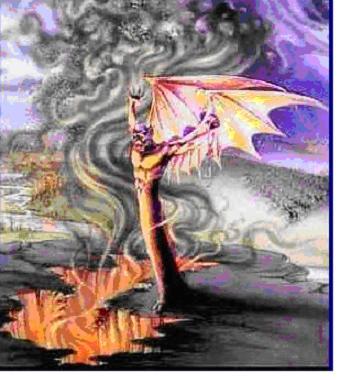


Reference: http://heavenawaits.wordpress.com/how-does-gog-and-magog-relate-to-armageddon/

Sunday, March 20, 2011

The Earth Without the Moon

Source: The Earth Without the Moon

The period when the Earth was Moonless is probably the most remote recollection of mankind. Democritus and Anaxagoras taught that there was a time when the Earth was without the Moon.(1) Aristotle wrote that Arcadia in Greece, before being inhabited by the Hellenes, had a population of Pelasgians, and that these aborigines occupied the land already before there was a moon in the sky above the Earth; for this reason they were called Proselenes.(2)

Apollonius of Rhodes mentioned the time “when not all the orbs were yet in the heavens, before the Danai and Deukalion races came into existence, and only the Arcadians lived, of whom it is said that they dwelt on mountains and fed on acorns, before there was a moon.” (3)

Plutarch wrote in The Roman Questions: “There were Arcadians of Evander’s following, the so-called pre-Lunar people.”(4) Similarly wrote Ovid: “The Arcadians are said to have possessed their land before the birth of Jove, and the folk is older than the Moon.” (5) Hippolytus refers to a legend that “Arcadia brought forth Pelasgus, of greater antiquity than the moon.”(6) Lucian in his Astrology says that “the Arcadians affirm in their folly that they are older than the moon.”(7)

Censorinus also alludes to the time in the past when there was no moon in the sky.(8)

Some allusions to the time before there was a Moon may be found also in the Scriptures. In Job 25:5 the grandeur of the Lord who “Makes peace in the heights” is praised and the time is mentioned “before [there was] a moon and it did not shine.” Also in Psalm 72:5 it is said: “Thou wast feared since [the time of] the sun and before [the time of] the moon, a generation of generations.” A “generation of generations” means a very long time. Of course, it is of no use to counter this psalm with the myth of the first chapter of Genesis, a tale brought down from exotic and later sources.

The memory of a world without a moon lives in oral tradition among the Indians. The Indians of the Bogota highlands in the eastern Cordilleras of Colombia relate some of their tribal reminiscences to the time before there was a moon. “In the earliest times, when the moon was not yet in the heavens,” say the tribesmen of Chibchas.(9)

There are currently three theories of the origin of the moon:

1) The Moon originated at the same time as the Earth, being formed substantially from the same material, aggregating and solidifying.

2) The Moon was formed not in the vicinity of the Earth, but in a different part of the solar system, and was later captured by the Earth.

3) The Moon was originally a portion of the terrestrial crust and was torn out, leaving behind the bed of the Pacific.

All three theories claim the presence of the Moon on an orbit around the Earth for billions of years. Mythology may supply each of these views with some support (Genesis I for the first view; the birth of Aphrodite from the sea for the third view; Aphrodite’s origin in the disruption of Uranus, and also the violence of Sin—the Babylonian Moon—seems to support the second view).

Since mankind on both sides of the Atlantic preserved the memory of a time when the Earth was without the Moon, the first hypothesis, namely, of the Moon originating simultaneously with the Earth and in its vicinity, is to be excluded, leaving the other two hypotheses to compete between themselves.

We have seen that the traditions of diverse peoples offer corroborative testimony to the effect that in a very early age, but still in the memory of mankind, no moon accompanied the Earth.(10) Since human beings already peopled the Earth, it is improbable that the Moon sprang from it: there must have existed a solid lithosphere, not a liquid earth. Thus while I do not claim to know the origin of the Moon, I find it more probable that the Moon was captured by the Earth. Such an event would have occurred as a catastrophe.(11) If the Moon’s formation took place away from the Earth,(12) its composition may be quite different.

There is no evidence to suggest whether the Moon was a planet, a satellite of another planet, or a comet at the time of its capture by the Earth. Whatever atmosphere it may have had(13) was pulled away by the Earth, by other contacting bodies, or dissipated in some other way.

Since the time the Moon began to accompany the Earth, it underwent the influence of contacts with comets and planets that passed near the Earth in subsequent ages. The mass of the Moon being less than that of the Earth, the Moon must have suffered greater disturbances in cosmic contacts. During these contacts the Moon was not carried away: this is due to the fact that no body more powerful than the Earth came sufficiently close to the Moon to take it away from the Earth for good; but in the contacts that took place the Moon was removed repeatedly from one orbit to another.

The variations in the position of the Moon can be read in the variations in the length of the month. The length of the month repeatedly changed in subseqent catastrophic events—and for this there exists a large amount of supporting evidence. In these later occurrences the Moon played a passive role, and Zeus in the Iliad advised it (Aphrodite) to stay out of the battle in which Athene and Ares (Venus and Mars) were the main contestants.

References

1.

Hippolytus, Refutatio Omnium Haeresium V. ii.
2.

Aristotle, fr. 591 (ed. V. Rose [Teubner:Tuebingen, 1886] ). Cf. Pauly’s Realencyclopaedie der classischen Altertumswissenschaft, article “Mond” ; H. Roscher, Lexicon d. griech. und roemisch. Mythologie, article “Proselenes.”
3.

Argonautica IV.264.
4.

Plutarch, Moralia, transl. by F. C. Babbit, sect. 76.
5.

Fasti, transl. by Sir J. Frazer, II. 290.
6.

Refutatio Omnium Haeresium V. ii.
7.

Lucian, Astrology, transl. by A. M. Harmon (1936), p. 367, par. 26.
8.

Liber de die natali 19; also scholium on Aristophanes’ Clouds, line 398.
9.

A. von Humboldt, Vues des Cordillères (1816), English transl.: Researches Concerning the Institutions and Monuments of the Ancient Inhabitants of America, (1814), vol. I, p. 87; cf. H. Fischer, In mondener Welt (1930), p. 145.
10.

[In addition to the sources cited above, cf. The Nihongi Chronicles of Japan (I.ii, in Transactions and Proceedings of the Japanese Society, vol. I [1896]) which recount how “Heaven and Earth . . . produced the Moon-god.” The Kalevala of the Finns recalls a time “when the Moon was placed in orbit.” (Rune III.35)]
11.

[Cf. the effects of such an event on the Earth’s rotation calculated by H. Gerstenkorn in Zeitschrift fuer Astrophysik, 36 (1955), p. 245; cf. idem, in Mantles of the Earth and the Terrestrial Planets, S. K. Runcorn ed., (New York, 1967); also idem in Icarus 9 (1968), p. 394.]
12.

[Cf. H. Alfven and G. Arrhenius, “Two Alternatives for the History of the Moon,” Science 165 (1969), 11ff.; S. F. Singer and L. W. Banderman, “Where was the Moon Formed?” Science 170 (1970), 438-439: “ . . . The moon was formed independently of the earth and later captured, presumably by a three-body interaction, and these events were followed by the dissipation of the excess energy through tidal friction in a close encounter.” More recently, a study of lunar paleotides has shown that “the Moon could not have been formed in orbit around the Earth” (A. J. Anderson, “Lunar Paleotides and the Origin of the Earth-Moon System,” The Moon and the Planets, 19 [1978], 409-417). Because of a certain degree of instability in the Sun-Earth-Moon system, “the planetary origin and capture of the Moon by the Earth becomes a strong dynamic possibility.” (V. Szebehely and R. McKenzie, “Stability of the Sun-Earth-Moon System,” The Astronomical Journal 82 (1977), 303ff.].
13.

[Cf. Yu. B. Chernyak, “On Recent Lunar Atmosphere,” Nature, 273 (15 June, 1978), pp. 497ff. The author found “strong theoretical evidence of a considerable atmosphere on the Moon during the greater part of its history.”]