Happy Easter! I'm not doing much, I just slept in cause I won't be getting much sleep from here until finals. It was nice. I woke up to find this article from the I'm into Egyptology page on facebook. Enjoy!
Source: http://english.ahram.org.eg/News/10483.aspx
Monday 25 April marks Sham El-Nasim, which Copts celebrate as part of Easter, but is one of the few days that Egyptians of all religions celebrate - since ancient times
Celebrated since 2700 BC by all Egyptians regardless of their religion, beliefs, and social status, the name Sham El-Nasim (Inhaling the breeze) is derived from the Coptic language that, in turn, is derived from the ancient Egyptian language. Originally pronounced Tshom Ni Sime, with tshom meaning “gardens” and ni sime meaning “meadows.”
Like most ancient Egyptian feasts, Sham El-Nasim was also affiliated with astronomy and nature. It marks the beginning of the spring festival, which is the time they believed day and night are equal, (when the sun is in the Aries zodiac) hence marking the beginning of creation. They confirm the exact date annually by sighting the sun in relation to the great pyramid. Ancient Egyptians named it The Feast of Shmo (the revival of life) and have officially celebrated it since 2700BC.
At the crack of dawn Egyptians usually leave their homes to have a picnic with their families in meadows and gardens to enjoy the breeze. On this national holiday the traditional Sham El-Nasim meal consists of fish, onions and eggs.
Fish was highly respected in ancient Egyptian beliefs. Salted mullet fish (known as fesikh), was offered to the gods in Esna in Upper Egypt to the extent that Esna’s ancient name was Lathpolis, which was the name of the original fish before it is salted.
As for colouring eggs, it’s a custom mentioned in the pharaoh’s famous Book of the Dead and in Akhenaton’s chants, “God is one, he created life from the inanimate and he created chicks from eggs.” Hence, the egg was a symbol of life to ancient Egyptians
Ancient Egyptians would boil eggs on Sham El-Nasim eve, decorate and colour them in various patterns, then write their wishes on these eggs, tuck them in baskets made of palm fronds and hang them on trees or the roof of their houses in hopes that the gods would answer their wishes by dawn.
The habit of eating onions on that day is equally ancient. According to Egyptian legends, one of the pharaoh’s daughters had an incurable disease. Doctors were clueless until a high priest started giving her a few drops of onion juice. Her condition improved and her father, thrilled, named that day “the onion coalition day.” That day people would roam the city of Menf and offer onions to their dead.
As for flowers and plants, ancient Egyptians considered them holy and the lotus flower was actually the symbol of the country in ancient times.
In ancient Egypt, families would combine all of these: they would gather on the eve of Sham El-Nasim to colour the boiled eggs, prepare the fesikh and onion, some hanging the onions on their door steps to ward off evil spirits and putting them under their grandchildren’s pillows that night to summon the god Sukar. Before dawn, people would head to meadows, gardens and the Nile river bank to watch the sunrise while carrying food and flowers. They spend their day out in the open air, joyfully singing away the hours.
Little has changed since the time of the Pharaohs, apparently.
Happy Sham El-Nasim!
Showing posts with label ancient. Show all posts
Showing posts with label ancient. Show all posts
Sunday, April 24, 2011

Thursday, March 31, 2011
Geocentric Galaxy

Pyramid on Mars
Mainstream archeologists say that the Egyptian pyramids were tombs. But contrary to that belief the Order of the Rosae Croix, a mystery school that was created by the Pharaohs of Egypt state that the Pyramids were created by Thought, or the Egyptian God Thoth. Thought is the Egyptian god THOTH, the creator of almost every activity known to man. Thought is spelled T H O T H. This god is responsible for the alphabet, writing, speaking, the sciences, religion, … you name it, and Thoth is responsible for it. Thoth's priests claimed Thoth was the Demi-Urge who created everything from sound. According to the Freemasons the Pyramids were tools of creation. What if we propose that the pyramids were responsible for the galaxy?
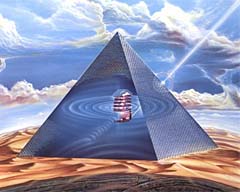
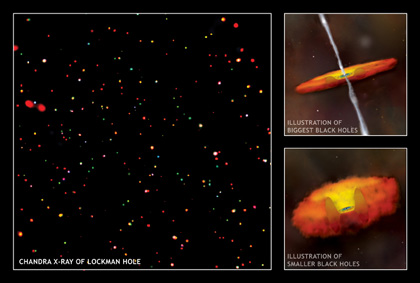
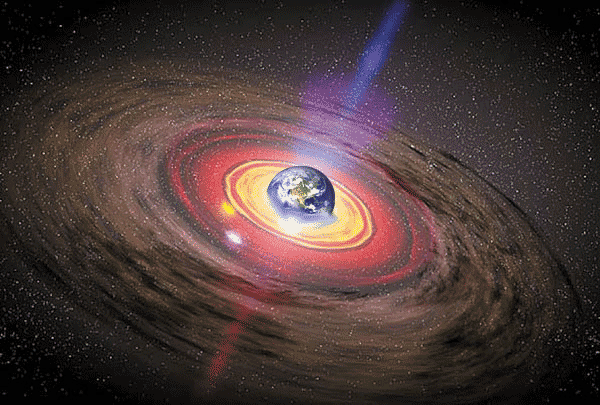
Research has been done investigating that the Egyptian pyramids were some kind of power plant.... thus illustrated as above. Though what came to mind about the angle of the beam was the angle of a beam coming out of a black hole:
Tuesday, March 29, 2011
Traveling Faster than the Speed of Light = Phi
One of the things that I have witnessed as a researcher in my erm, "field" .. is the serious misunderstanding of the paradigm of science. The scientific method is so friggen dogmatic its not even funny. One of the reasons for this dogma is that as a society we're not spiritually involved enough to really comprehend the galaxy and the nature of the physical universe. For 2,000 years we've been fighting over at whose God is "better"... ,etc.
One of the misunderstandings that I have observed is what happens to matter as it reaches the center of a galaxy. We're told that at the center of the galaxy matter is crushed. But then how come, when observing an astrophotograph of a galaxy, the center is a shining white ball of light?!

Keep in mind that when the Hubble Telescope photographs an object in space it is using a really high frequency technology to capture the high frequency light of the object. Therefore, it seems that the scientific method is going strictly by the definition of "observing". If they can't observe it with the naked eye or dissect it, then it simply does not exist, or that it isn't science and thus transitions into the more metaphysical thought-process.
Did our ancestors know about traveling faster than the speed of light?
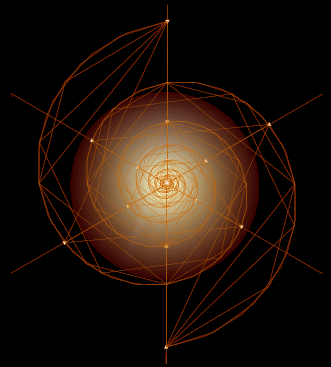
The Canadian website, Spira Solaris, goes into depth on the phyllotaxis nature of the solar system to the phyllotaxis movement of the arrangement of leaves.
One will say that the above is an illustration of a rather Pythagorean idea however despite being known as a philosopher in the 6th century BC. He was often known as a mathematician, mystic and scientist. He even went to Egypt in search of knowledge, probably ending up at a mystery school in which he learned the mystical ways.
On Spira Solaris, there is an appendix titled, THE MATTER OF LOST LIGHT and goes into detail how PHI could be the source of the spiral form in nature. I then wondered what light was in ancient Greek and then using a translator translated light. The first letter of light in ancient Greek is PHI. The ancient Egyptians even called Matter "Frozen Music".

Gamma Ray burst at the center, more evidence of matter turning into light.
If PHI (1.61803399) really is the secret mathematical expression to convert matter into light energy (again), we would then be able to keep the energy consistent.
Mmm. Let's pull up a scenario.
Then the 31.44520... m/s is the amount of energy carbon would deliver. If only there was a way to truly test this.
One of the misunderstandings that I have observed is what happens to matter as it reaches the center of a galaxy. We're told that at the center of the galaxy matter is crushed. But then how come, when observing an astrophotograph of a galaxy, the center is a shining white ball of light?!
Keep in mind that when the Hubble Telescope photographs an object in space it is using a really high frequency technology to capture the high frequency light of the object. Therefore, it seems that the scientific method is going strictly by the definition of "observing". If they can't observe it with the naked eye or dissect it, then it simply does not exist, or that it isn't science and thus transitions into the more metaphysical thought-process.
Did our ancestors know about traveling faster than the speed of light?
The Canadian website, Spira Solaris, goes into depth on the phyllotaxis nature of the solar system to the phyllotaxis movement of the arrangement of leaves.
It is well known that the arrangement of the leaves in plantsmay be expressed by very simple series of fractions, all of which are gradual approximations to, or the natural means between 1/2 or 1/3, which two fractions are themselves the maximum and the minimum divergence between two single successive leaves. The normal series of fractions which expresses the various combinations most frequently observed among the leaves of plants is as follows: 1/2, 1/3, 2/5, 3/8, 5/13, 8/21, 13/34, 21/55, etc. Now upon comparing this arrangement of the leaves in plants with the revolutions of the members of our solar system, Peirce has discovered the most perfect identity between the fundamental laws which regulate both. 1
(Louis Agassiz, ESSAY ON CLASSIFICATION, Ed. E. Lurie, Belknap Press, Cambridge, 1962:127; emphases supplied)
One will say that the above is an illustration of a rather Pythagorean idea however despite being known as a philosopher in the 6th century BC. He was often known as a mathematician, mystic and scientist. He even went to Egypt in search of knowledge, probably ending up at a mystery school in which he learned the mystical ways.
On Spira Solaris, there is an appendix titled, THE MATTER OF LOST LIGHT and goes into detail how PHI could be the source of the spiral form in nature. I then wondered what light was in ancient Greek and then using a translator translated light. The first letter of light in ancient Greek is PHI. The ancient Egyptians even called Matter "Frozen Music".
Gamma Ray burst at the center, more evidence of matter turning into light.
If PHI (1.61803399) really is the secret mathematical expression to convert matter into light energy (again), we would then be able to keep the energy consistent.
Mmm. Let's pull up a scenario.
Okay, so Einstein's equation was, E=MC2.
According to Sixty Symbols, they do not know what C2 is. Generally they would say that C is constant; consistency. Spiral form is the best for consistency.
Let's plug in 1.61803399 into E=MC2.
E = M • (1.61803399)2
When matter is squared by PHI, matter dematerializes and becomes light again.
Let's take the atomic mass of carbon and put it into our revised version of Einstein's equation.
E = 12.011 • (1.61803399)2
E = 12.011 • 2.61803399
E (light) = 31.44520625398 m/s ( miles per second)
Then the 31.44520... m/s is the amount of energy carbon would deliver. If only there was a way to truly test this.
Friday, March 25, 2011
Makeup - Ancient Makeup?


I'm a HUGE fan of makeup and its a big inspiration for me. I love playing with color and makeup is a way for me to do that. Mixing and matching shades I normally wouldn't wear into a wearable look. Makeup can be extremely artistic when done right.


Did you know makeup is extremely ancient too? The idea of the black eyeliner came from the ancient Egyptians.


Ancient Egyptian makeup tools

Ancient makeup pots!
All ancient Egyptians wore makeup even children.
Sunday, March 20, 2011
The Earth Without the Moon
Source: The Earth Without the Moon
The period when the Earth was Moonless is probably the most remote recollection of mankind. Democritus and Anaxagoras taught that there was a time when the Earth was without the Moon.(1) Aristotle wrote that Arcadia in Greece, before being inhabited by the Hellenes, had a population of Pelasgians, and that these aborigines occupied the land already before there was a moon in the sky above the Earth; for this reason they were called Proselenes.(2)
Apollonius of Rhodes mentioned the time “when not all the orbs were yet in the heavens, before the Danai and Deukalion races came into existence, and only the Arcadians lived, of whom it is said that they dwelt on mountains and fed on acorns, before there was a moon.” (3)
Plutarch wrote in The Roman Questions: “There were Arcadians of Evander’s following, the so-called pre-Lunar people.”(4) Similarly wrote Ovid: “The Arcadians are said to have possessed their land before the birth of Jove, and the folk is older than the Moon.” (5) Hippolytus refers to a legend that “Arcadia brought forth Pelasgus, of greater antiquity than the moon.”(6) Lucian in his Astrology says that “the Arcadians affirm in their folly that they are older than the moon.”(7)
Censorinus also alludes to the time in the past when there was no moon in the sky.(8)
Some allusions to the time before there was a Moon may be found also in the Scriptures. In Job 25:5 the grandeur of the Lord who “Makes peace in the heights” is praised and the time is mentioned “before [there was] a moon and it did not shine.” Also in Psalm 72:5 it is said: “Thou wast feared since [the time of] the sun and before [the time of] the moon, a generation of generations.” A “generation of generations” means a very long time. Of course, it is of no use to counter this psalm with the myth of the first chapter of Genesis, a tale brought down from exotic and later sources.
The memory of a world without a moon lives in oral tradition among the Indians. The Indians of the Bogota highlands in the eastern Cordilleras of Colombia relate some of their tribal reminiscences to the time before there was a moon. “In the earliest times, when the moon was not yet in the heavens,” say the tribesmen of Chibchas.(9)
There are currently three theories of the origin of the moon:
1) The Moon originated at the same time as the Earth, being formed substantially from the same material, aggregating and solidifying.
2) The Moon was formed not in the vicinity of the Earth, but in a different part of the solar system, and was later captured by the Earth.
3) The Moon was originally a portion of the terrestrial crust and was torn out, leaving behind the bed of the Pacific.
All three theories claim the presence of the Moon on an orbit around the Earth for billions of years. Mythology may supply each of these views with some support (Genesis I for the first view; the birth of Aphrodite from the sea for the third view; Aphrodite’s origin in the disruption of Uranus, and also the violence of Sin—the Babylonian Moon—seems to support the second view).
Since mankind on both sides of the Atlantic preserved the memory of a time when the Earth was without the Moon, the first hypothesis, namely, of the Moon originating simultaneously with the Earth and in its vicinity, is to be excluded, leaving the other two hypotheses to compete between themselves.
We have seen that the traditions of diverse peoples offer corroborative testimony to the effect that in a very early age, but still in the memory of mankind, no moon accompanied the Earth.(10) Since human beings already peopled the Earth, it is improbable that the Moon sprang from it: there must have existed a solid lithosphere, not a liquid earth. Thus while I do not claim to know the origin of the Moon, I find it more probable that the Moon was captured by the Earth. Such an event would have occurred as a catastrophe.(11) If the Moon’s formation took place away from the Earth,(12) its composition may be quite different.
There is no evidence to suggest whether the Moon was a planet, a satellite of another planet, or a comet at the time of its capture by the Earth. Whatever atmosphere it may have had(13) was pulled away by the Earth, by other contacting bodies, or dissipated in some other way.
Since the time the Moon began to accompany the Earth, it underwent the influence of contacts with comets and planets that passed near the Earth in subsequent ages. The mass of the Moon being less than that of the Earth, the Moon must have suffered greater disturbances in cosmic contacts. During these contacts the Moon was not carried away: this is due to the fact that no body more powerful than the Earth came sufficiently close to the Moon to take it away from the Earth for good; but in the contacts that took place the Moon was removed repeatedly from one orbit to another.
The variations in the position of the Moon can be read in the variations in the length of the month. The length of the month repeatedly changed in subseqent catastrophic events—and for this there exists a large amount of supporting evidence. In these later occurrences the Moon played a passive role, and Zeus in the Iliad advised it (Aphrodite) to stay out of the battle in which Athene and Ares (Venus and Mars) were the main contestants.
References
1.
Hippolytus, Refutatio Omnium Haeresium V. ii.
2.
Aristotle, fr. 591 (ed. V. Rose [Teubner:Tuebingen, 1886] ). Cf. Pauly’s Realencyclopaedie der classischen Altertumswissenschaft, article “Mond” ; H. Roscher, Lexicon d. griech. und roemisch. Mythologie, article “Proselenes.”
3.
Argonautica IV.264.
4.
Plutarch, Moralia, transl. by F. C. Babbit, sect. 76.
5.
Fasti, transl. by Sir J. Frazer, II. 290.
6.
Refutatio Omnium Haeresium V. ii.
7.
Lucian, Astrology, transl. by A. M. Harmon (1936), p. 367, par. 26.
8.
Liber de die natali 19; also scholium on Aristophanes’ Clouds, line 398.
9.
A. von Humboldt, Vues des Cordillères (1816), English transl.: Researches Concerning the Institutions and Monuments of the Ancient Inhabitants of America, (1814), vol. I, p. 87; cf. H. Fischer, In mondener Welt (1930), p. 145.
10.
[In addition to the sources cited above, cf. The Nihongi Chronicles of Japan (I.ii, in Transactions and Proceedings of the Japanese Society, vol. I [1896]) which recount how “Heaven and Earth . . . produced the Moon-god.” The Kalevala of the Finns recalls a time “when the Moon was placed in orbit.” (Rune III.35)]
11.
[Cf. the effects of such an event on the Earth’s rotation calculated by H. Gerstenkorn in Zeitschrift fuer Astrophysik, 36 (1955), p. 245; cf. idem, in Mantles of the Earth and the Terrestrial Planets, S. K. Runcorn ed., (New York, 1967); also idem in Icarus 9 (1968), p. 394.]
12.
[Cf. H. Alfven and G. Arrhenius, “Two Alternatives for the History of the Moon,” Science 165 (1969), 11ff.; S. F. Singer and L. W. Banderman, “Where was the Moon Formed?” Science 170 (1970), 438-439: “ . . . The moon was formed independently of the earth and later captured, presumably by a three-body interaction, and these events were followed by the dissipation of the excess energy through tidal friction in a close encounter.” More recently, a study of lunar paleotides has shown that “the Moon could not have been formed in orbit around the Earth” (A. J. Anderson, “Lunar Paleotides and the Origin of the Earth-Moon System,” The Moon and the Planets, 19 [1978], 409-417). Because of a certain degree of instability in the Sun-Earth-Moon system, “the planetary origin and capture of the Moon by the Earth becomes a strong dynamic possibility.” (V. Szebehely and R. McKenzie, “Stability of the Sun-Earth-Moon System,” The Astronomical Journal 82 (1977), 303ff.].
13.
[Cf. Yu. B. Chernyak, “On Recent Lunar Atmosphere,” Nature, 273 (15 June, 1978), pp. 497ff. The author found “strong theoretical evidence of a considerable atmosphere on the Moon during the greater part of its history.”]
The period when the Earth was Moonless is probably the most remote recollection of mankind. Democritus and Anaxagoras taught that there was a time when the Earth was without the Moon.(1) Aristotle wrote that Arcadia in Greece, before being inhabited by the Hellenes, had a population of Pelasgians, and that these aborigines occupied the land already before there was a moon in the sky above the Earth; for this reason they were called Proselenes.(2)
Apollonius of Rhodes mentioned the time “when not all the orbs were yet in the heavens, before the Danai and Deukalion races came into existence, and only the Arcadians lived, of whom it is said that they dwelt on mountains and fed on acorns, before there was a moon.” (3)
Plutarch wrote in The Roman Questions: “There were Arcadians of Evander’s following, the so-called pre-Lunar people.”(4) Similarly wrote Ovid: “The Arcadians are said to have possessed their land before the birth of Jove, and the folk is older than the Moon.” (5) Hippolytus refers to a legend that “Arcadia brought forth Pelasgus, of greater antiquity than the moon.”(6) Lucian in his Astrology says that “the Arcadians affirm in their folly that they are older than the moon.”(7)
Censorinus also alludes to the time in the past when there was no moon in the sky.(8)
Some allusions to the time before there was a Moon may be found also in the Scriptures. In Job 25:5 the grandeur of the Lord who “Makes peace in the heights” is praised and the time is mentioned “before [there was] a moon and it did not shine.” Also in Psalm 72:5 it is said: “Thou wast feared since [the time of] the sun and before [the time of] the moon, a generation of generations.” A “generation of generations” means a very long time. Of course, it is of no use to counter this psalm with the myth of the first chapter of Genesis, a tale brought down from exotic and later sources.
The memory of a world without a moon lives in oral tradition among the Indians. The Indians of the Bogota highlands in the eastern Cordilleras of Colombia relate some of their tribal reminiscences to the time before there was a moon. “In the earliest times, when the moon was not yet in the heavens,” say the tribesmen of Chibchas.(9)
There are currently three theories of the origin of the moon:
1) The Moon originated at the same time as the Earth, being formed substantially from the same material, aggregating and solidifying.
2) The Moon was formed not in the vicinity of the Earth, but in a different part of the solar system, and was later captured by the Earth.
3) The Moon was originally a portion of the terrestrial crust and was torn out, leaving behind the bed of the Pacific.
All three theories claim the presence of the Moon on an orbit around the Earth for billions of years. Mythology may supply each of these views with some support (Genesis I for the first view; the birth of Aphrodite from the sea for the third view; Aphrodite’s origin in the disruption of Uranus, and also the violence of Sin—the Babylonian Moon—seems to support the second view).
Since mankind on both sides of the Atlantic preserved the memory of a time when the Earth was without the Moon, the first hypothesis, namely, of the Moon originating simultaneously with the Earth and in its vicinity, is to be excluded, leaving the other two hypotheses to compete between themselves.
We have seen that the traditions of diverse peoples offer corroborative testimony to the effect that in a very early age, but still in the memory of mankind, no moon accompanied the Earth.(10) Since human beings already peopled the Earth, it is improbable that the Moon sprang from it: there must have existed a solid lithosphere, not a liquid earth. Thus while I do not claim to know the origin of the Moon, I find it more probable that the Moon was captured by the Earth. Such an event would have occurred as a catastrophe.(11) If the Moon’s formation took place away from the Earth,(12) its composition may be quite different.
There is no evidence to suggest whether the Moon was a planet, a satellite of another planet, or a comet at the time of its capture by the Earth. Whatever atmosphere it may have had(13) was pulled away by the Earth, by other contacting bodies, or dissipated in some other way.
Since the time the Moon began to accompany the Earth, it underwent the influence of contacts with comets and planets that passed near the Earth in subsequent ages. The mass of the Moon being less than that of the Earth, the Moon must have suffered greater disturbances in cosmic contacts. During these contacts the Moon was not carried away: this is due to the fact that no body more powerful than the Earth came sufficiently close to the Moon to take it away from the Earth for good; but in the contacts that took place the Moon was removed repeatedly from one orbit to another.
The variations in the position of the Moon can be read in the variations in the length of the month. The length of the month repeatedly changed in subseqent catastrophic events—and for this there exists a large amount of supporting evidence. In these later occurrences the Moon played a passive role, and Zeus in the Iliad advised it (Aphrodite) to stay out of the battle in which Athene and Ares (Venus and Mars) were the main contestants.
References
1.
Hippolytus, Refutatio Omnium Haeresium V. ii.
2.
Aristotle, fr. 591 (ed. V. Rose [Teubner:Tuebingen, 1886] ). Cf. Pauly’s Realencyclopaedie der classischen Altertumswissenschaft, article “Mond” ; H. Roscher, Lexicon d. griech. und roemisch. Mythologie, article “Proselenes.”
3.
Argonautica IV.264.
4.
Plutarch, Moralia, transl. by F. C. Babbit, sect. 76.
5.
Fasti, transl. by Sir J. Frazer, II. 290.
6.
Refutatio Omnium Haeresium V. ii.
7.
Lucian, Astrology, transl. by A. M. Harmon (1936), p. 367, par. 26.
8.
Liber de die natali 19; also scholium on Aristophanes’ Clouds, line 398.
9.
A. von Humboldt, Vues des Cordillères (1816), English transl.: Researches Concerning the Institutions and Monuments of the Ancient Inhabitants of America, (1814), vol. I, p. 87; cf. H. Fischer, In mondener Welt (1930), p. 145.
10.
[In addition to the sources cited above, cf. The Nihongi Chronicles of Japan (I.ii, in Transactions and Proceedings of the Japanese Society, vol. I [1896]) which recount how “Heaven and Earth . . . produced the Moon-god.” The Kalevala of the Finns recalls a time “when the Moon was placed in orbit.” (Rune III.35)]
11.
[Cf. the effects of such an event on the Earth’s rotation calculated by H. Gerstenkorn in Zeitschrift fuer Astrophysik, 36 (1955), p. 245; cf. idem, in Mantles of the Earth and the Terrestrial Planets, S. K. Runcorn ed., (New York, 1967); also idem in Icarus 9 (1968), p. 394.]
12.
[Cf. H. Alfven and G. Arrhenius, “Two Alternatives for the History of the Moon,” Science 165 (1969), 11ff.; S. F. Singer and L. W. Banderman, “Where was the Moon Formed?” Science 170 (1970), 438-439: “ . . . The moon was formed independently of the earth and later captured, presumably by a three-body interaction, and these events were followed by the dissipation of the excess energy through tidal friction in a close encounter.” More recently, a study of lunar paleotides has shown that “the Moon could not have been formed in orbit around the Earth” (A. J. Anderson, “Lunar Paleotides and the Origin of the Earth-Moon System,” The Moon and the Planets, 19 [1978], 409-417). Because of a certain degree of instability in the Sun-Earth-Moon system, “the planetary origin and capture of the Moon by the Earth becomes a strong dynamic possibility.” (V. Szebehely and R. McKenzie, “Stability of the Sun-Earth-Moon System,” The Astronomical Journal 82 (1977), 303ff.].
13.
[Cf. Yu. B. Chernyak, “On Recent Lunar Atmosphere,” Nature, 273 (15 June, 1978), pp. 497ff. The author found “strong theoretical evidence of a considerable atmosphere on the Moon during the greater part of its history.”]
Subscribe to:
Posts (Atom)